 MABEL
MABEL
MABEL
MABEL
Drive MABEL three ways — a browser console you can try right now, an iPhone in your pocket, and an Apple Vision Pro you reach through. All three speak one wire protocol to the same bridge, and point at the MuJoCo twin or the real robot with no change. Every session is also a training demo.
Three views — Teleop, Body, Navigate — over one robot. Press Connect to reach a live bridge; with none reachable, an in-browser kinematic twin keeps every control live. Same teleop_frame protocol as the iPhone and Vision Pro apps.
Joysticks, body control, and navigation over a live MuJoCo simulation — the same wire protocol as the iPhone and Vision Pro apps. The hosted sim may be offline; either way the controls stay live on the in-browser model.
The console above is the simplified one — the basics, so anyone can try the controller and feel each control mode. The Control Center is the feature-rich studio the robot hosts for real operating sessions: an rviz-class 3D viewer (live rig inside its own SLAM reconstruction, 2D map, LiDAR, camera frusta), drive + manipulate teleop with a draggable IK target ball, per-finger dexterous-hand control, a 59-DOF telemetry band with temperature grading, a pose-setpoint timeline, and a live monitor of every client connected to the server you are driving through.
The same five tabs, floating as glass — every window below is a real capture from the visionOS Simulator. Put the headset on and MABEL's stereo feed wraps around you; step into the immersive room and your hands are the arms — a pinch closes the grasp, your gaze aims the neck. 27 joints per hand at 60 Hz.
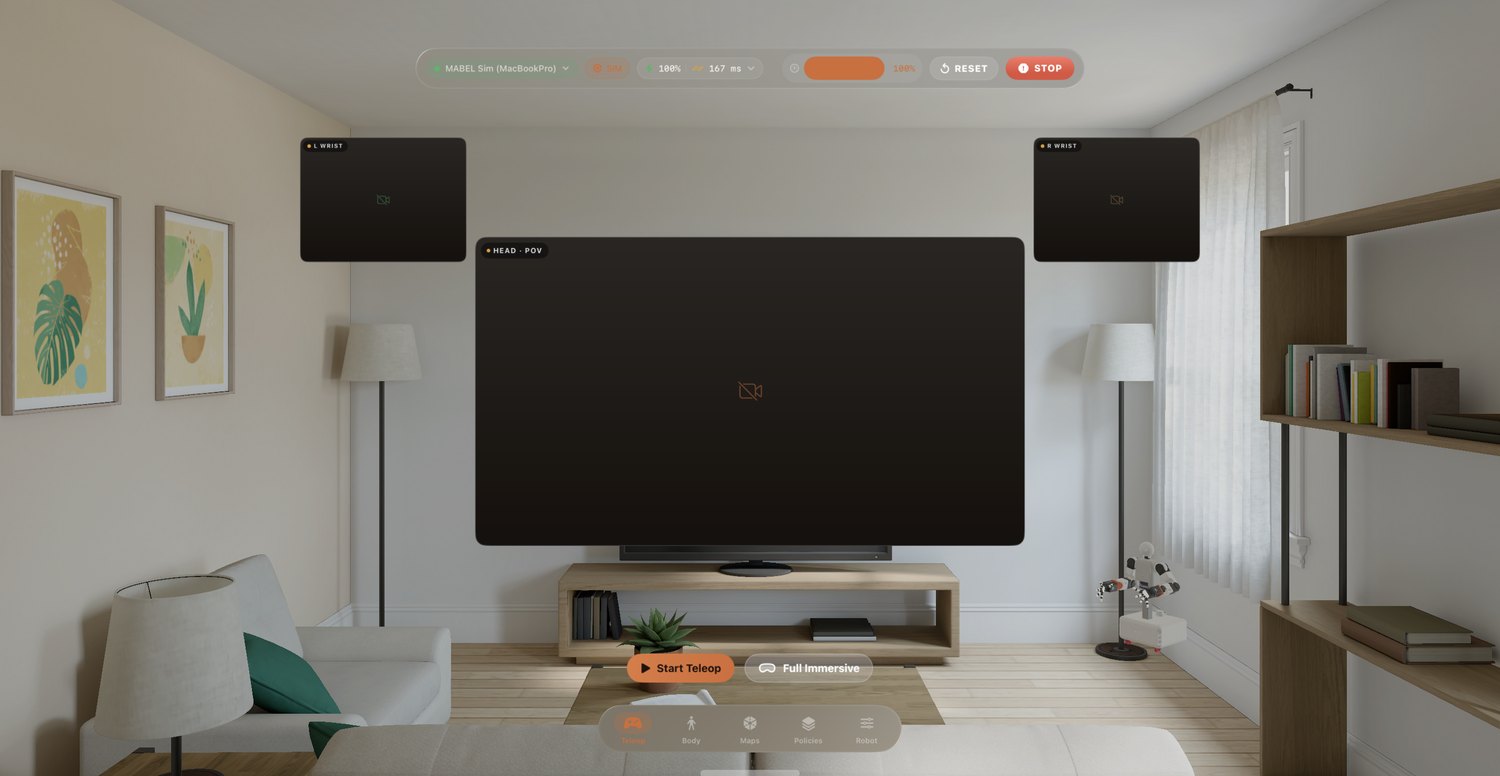
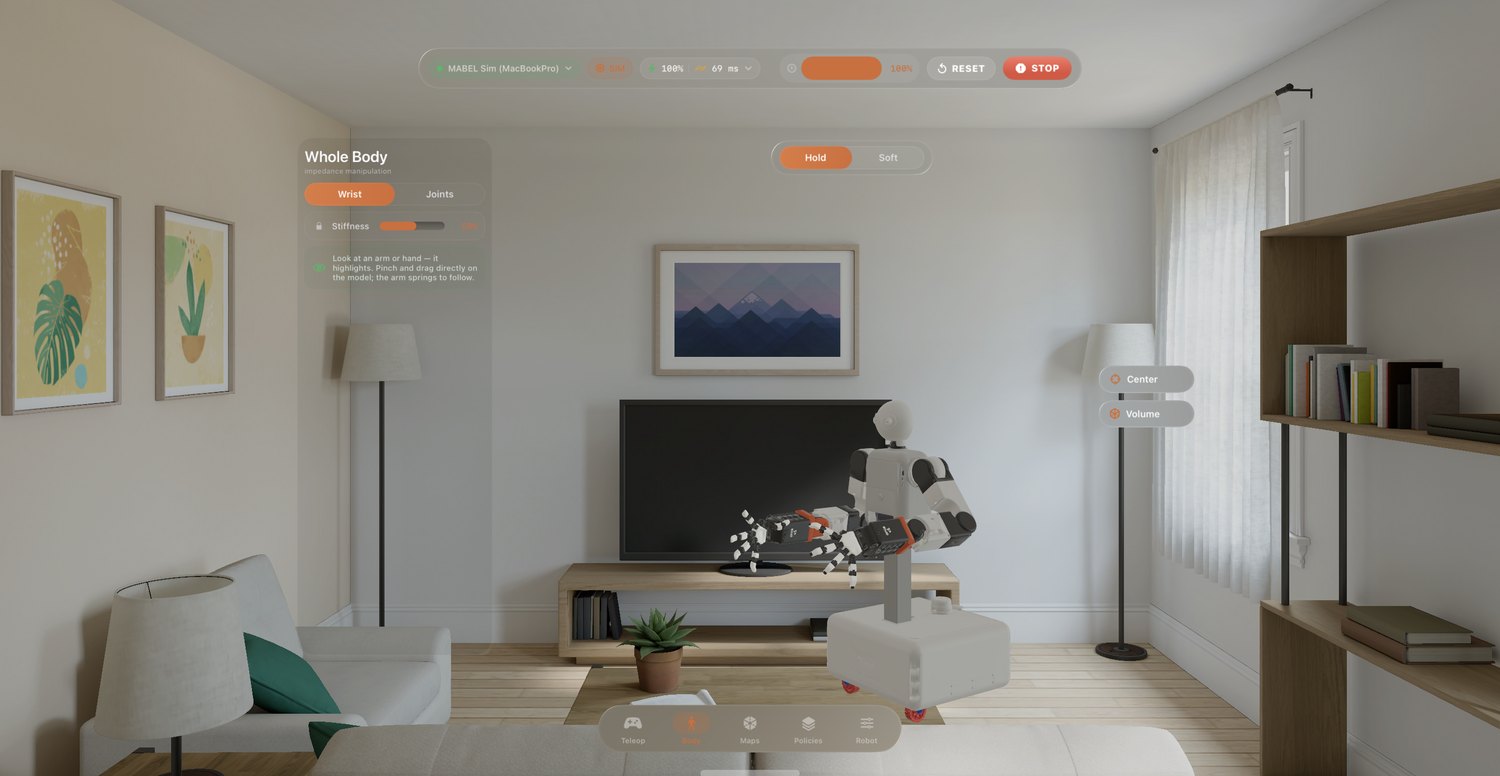
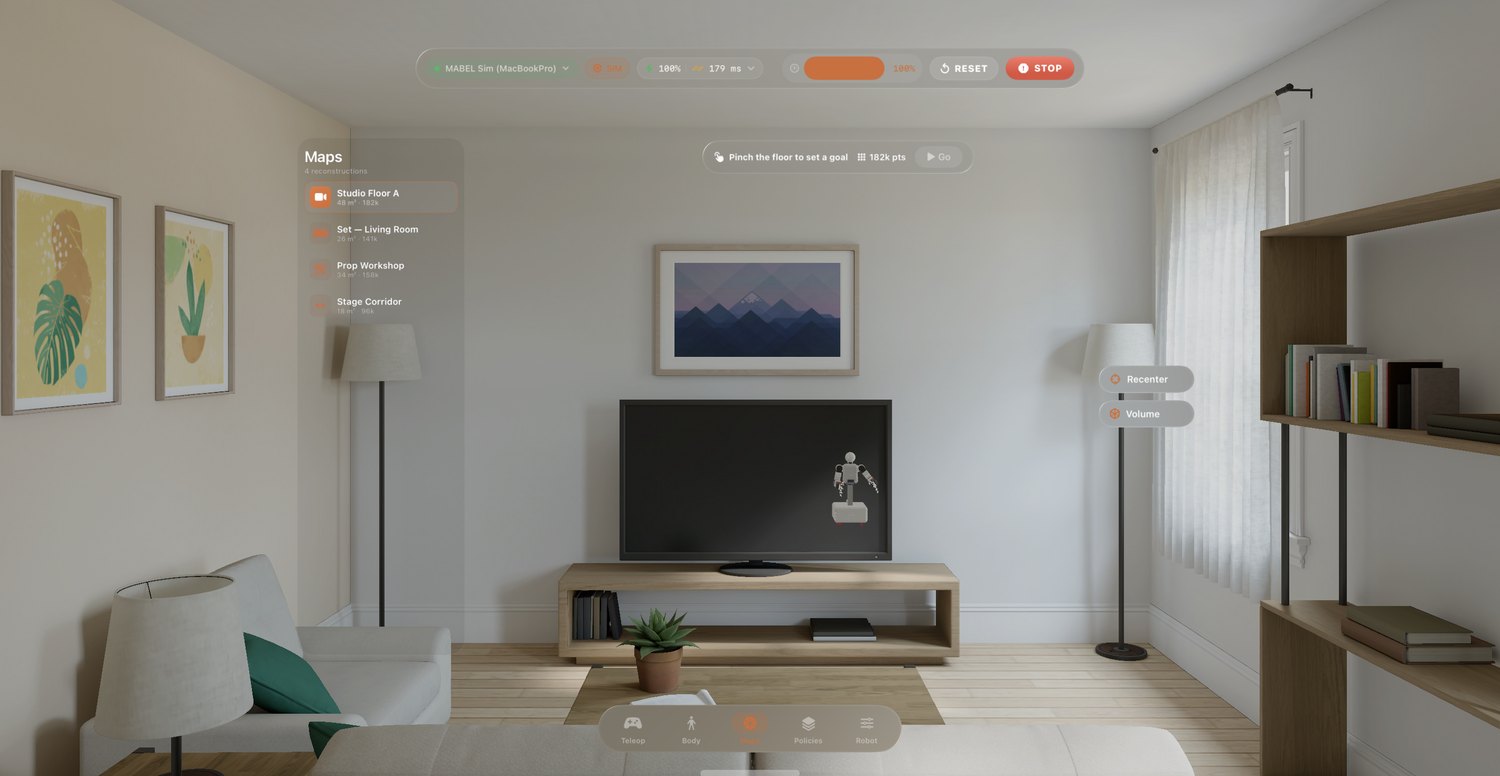
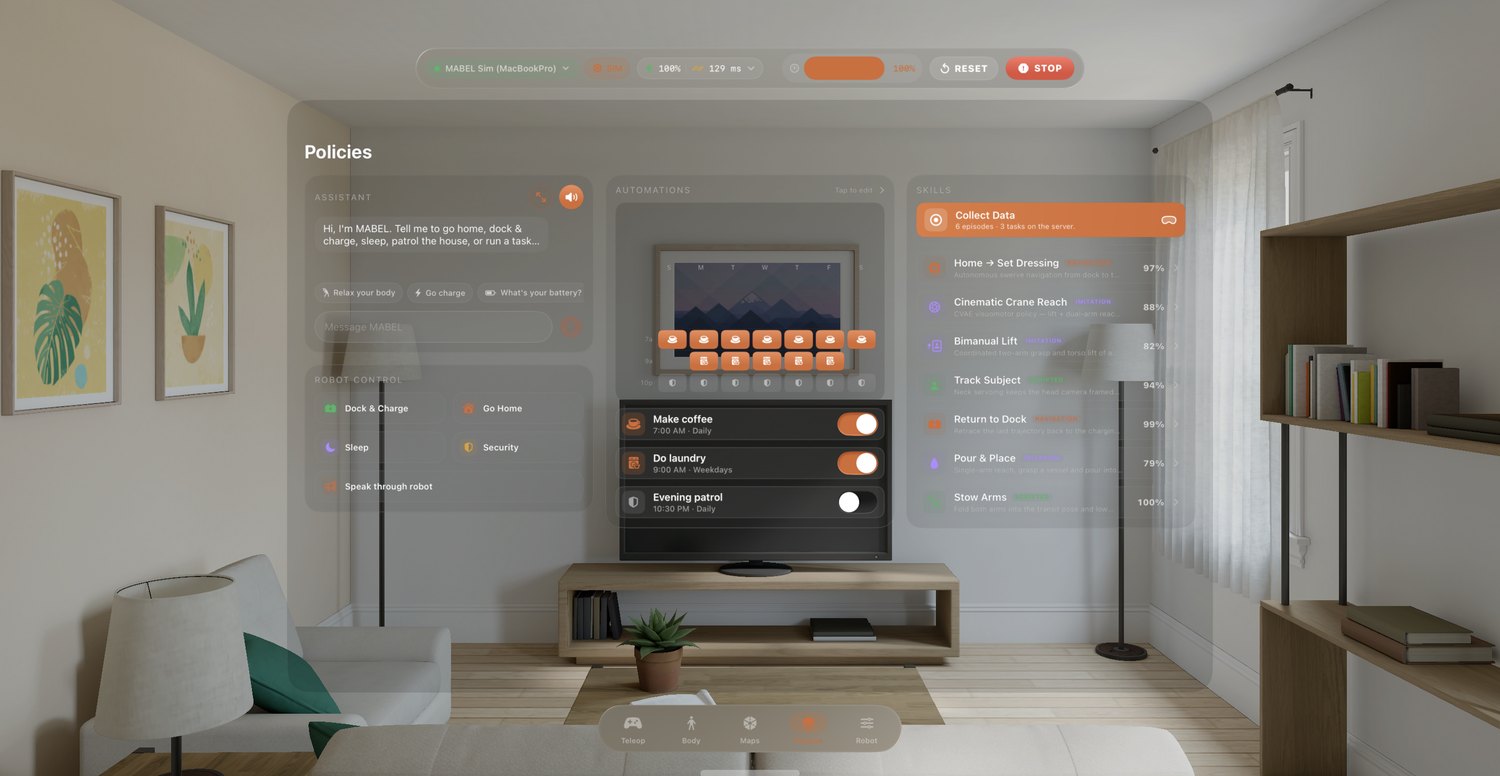
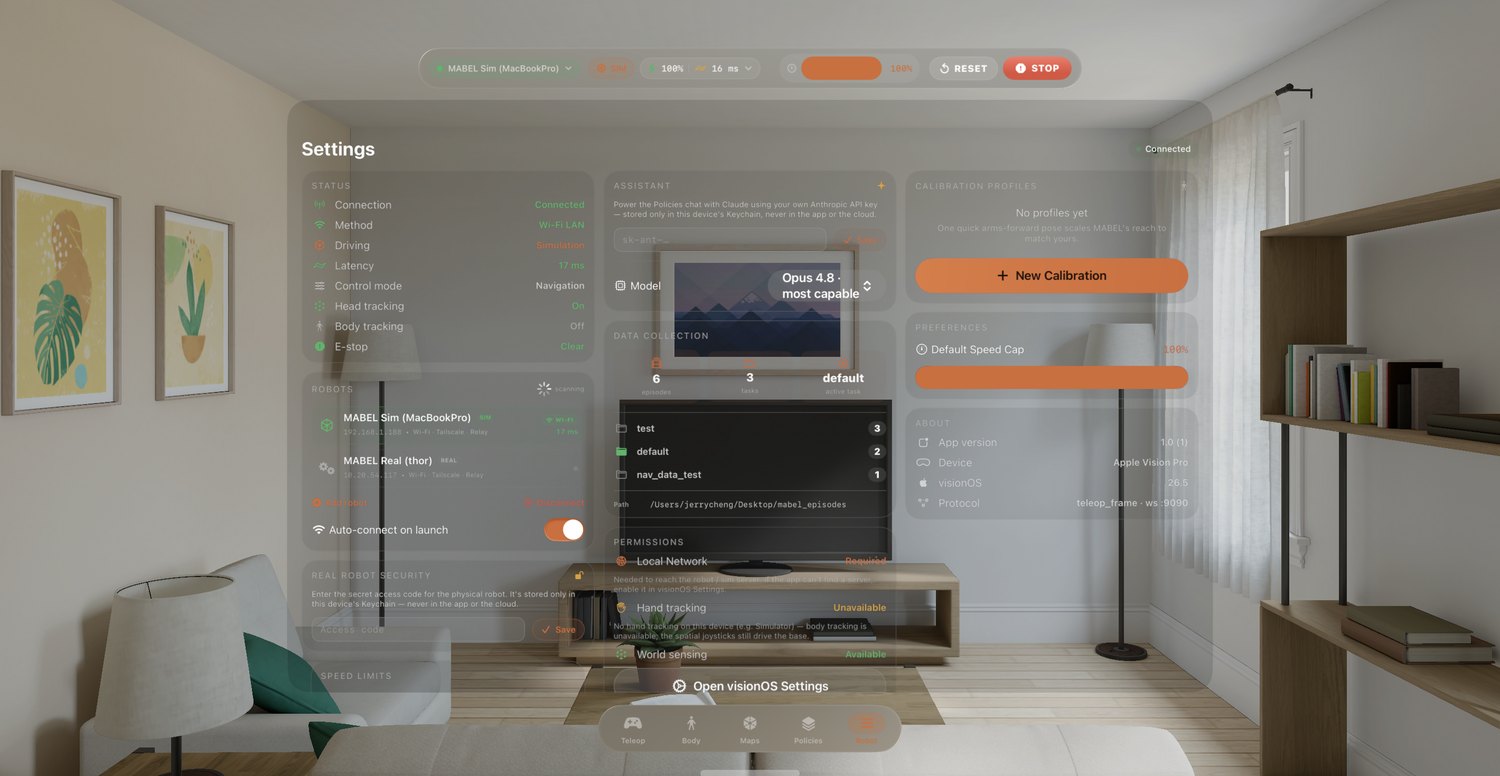
The head ZED's left/right streams map onto an inward-facing RealityKit sphere — you look around the robot's world in true stereo, with wrist-cam thumbnails for close work.
A UMI-style relative mapping: pinch to clutch in, move, release to re-anchor — no jumps. Thumb-to-index distance becomes the grasp. See retargeting.
Hand targets feed the control cascade; a lazy swerve base and a look-at neck come along for free. One headset drives all 51 joints.
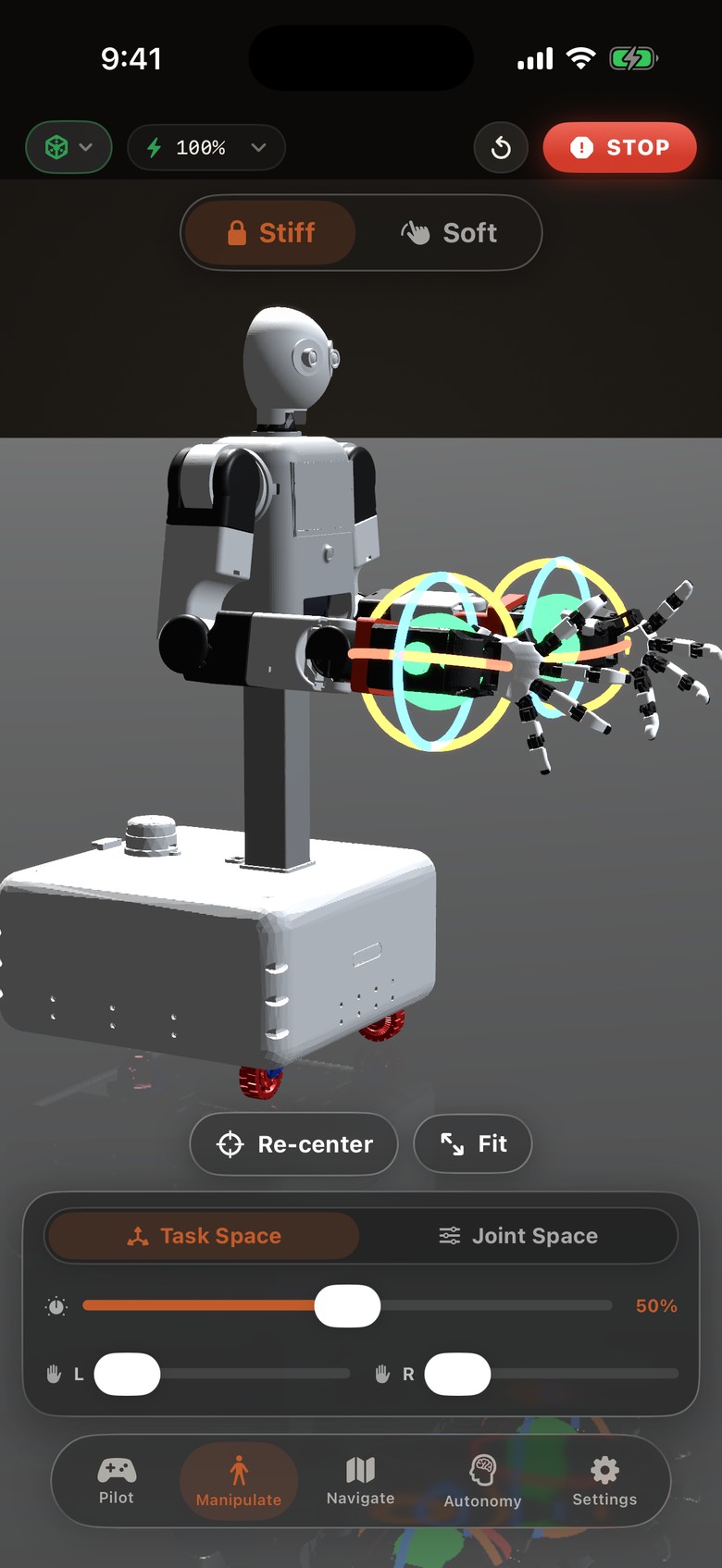
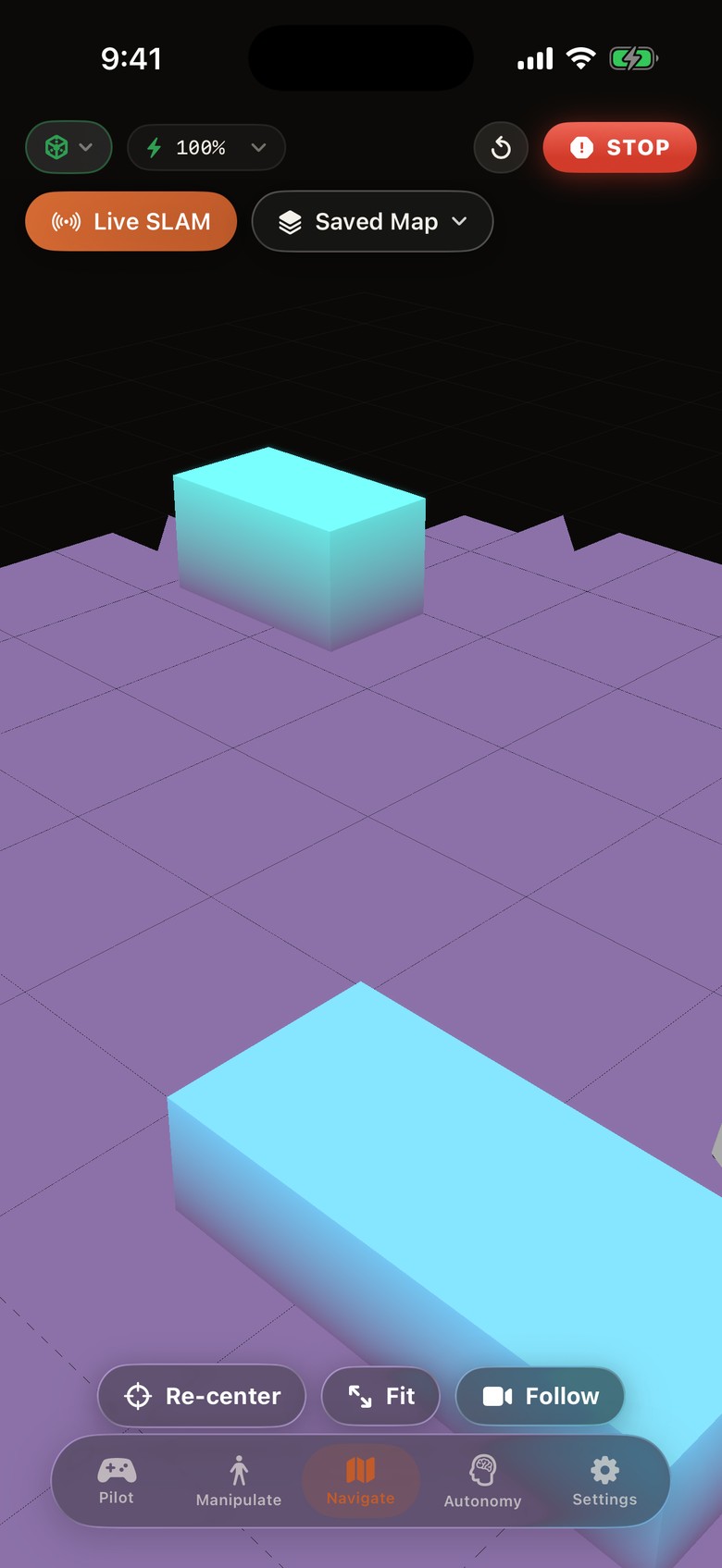
All five tabs, one thumb — every screen below is a real capture from the iOS Simulator. It auto-discovers MABEL on Wi-Fi and falls back to an on-device simulator, so every control stays live even with no robot in the room.
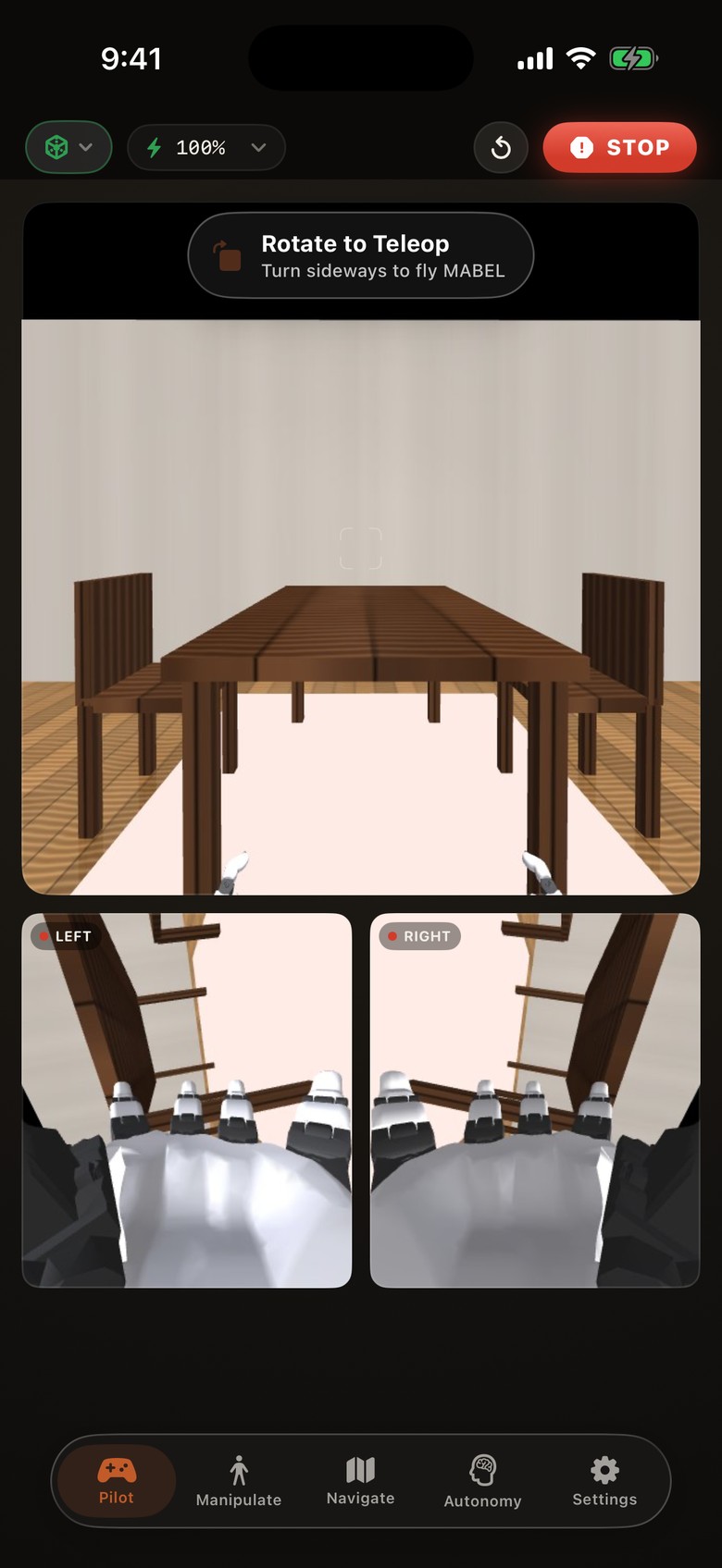
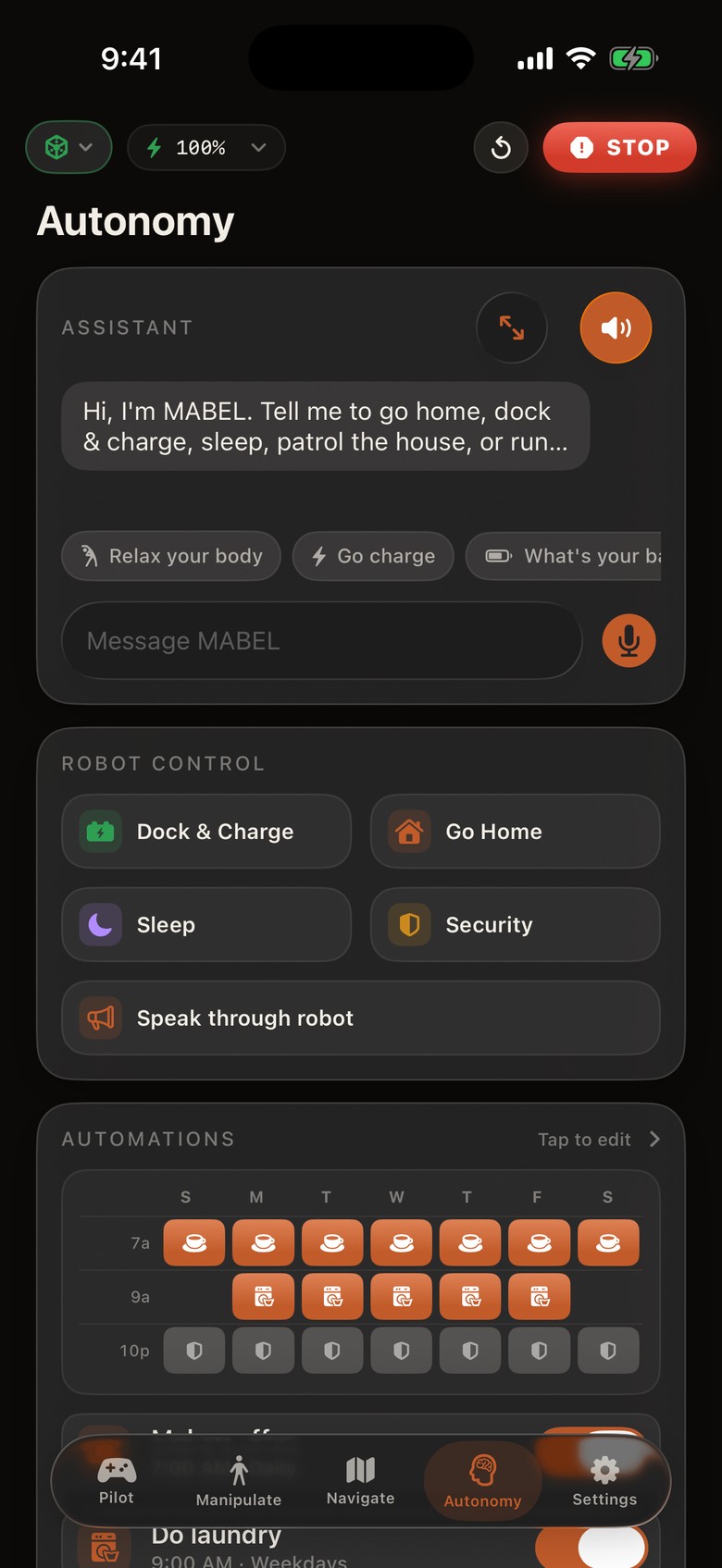
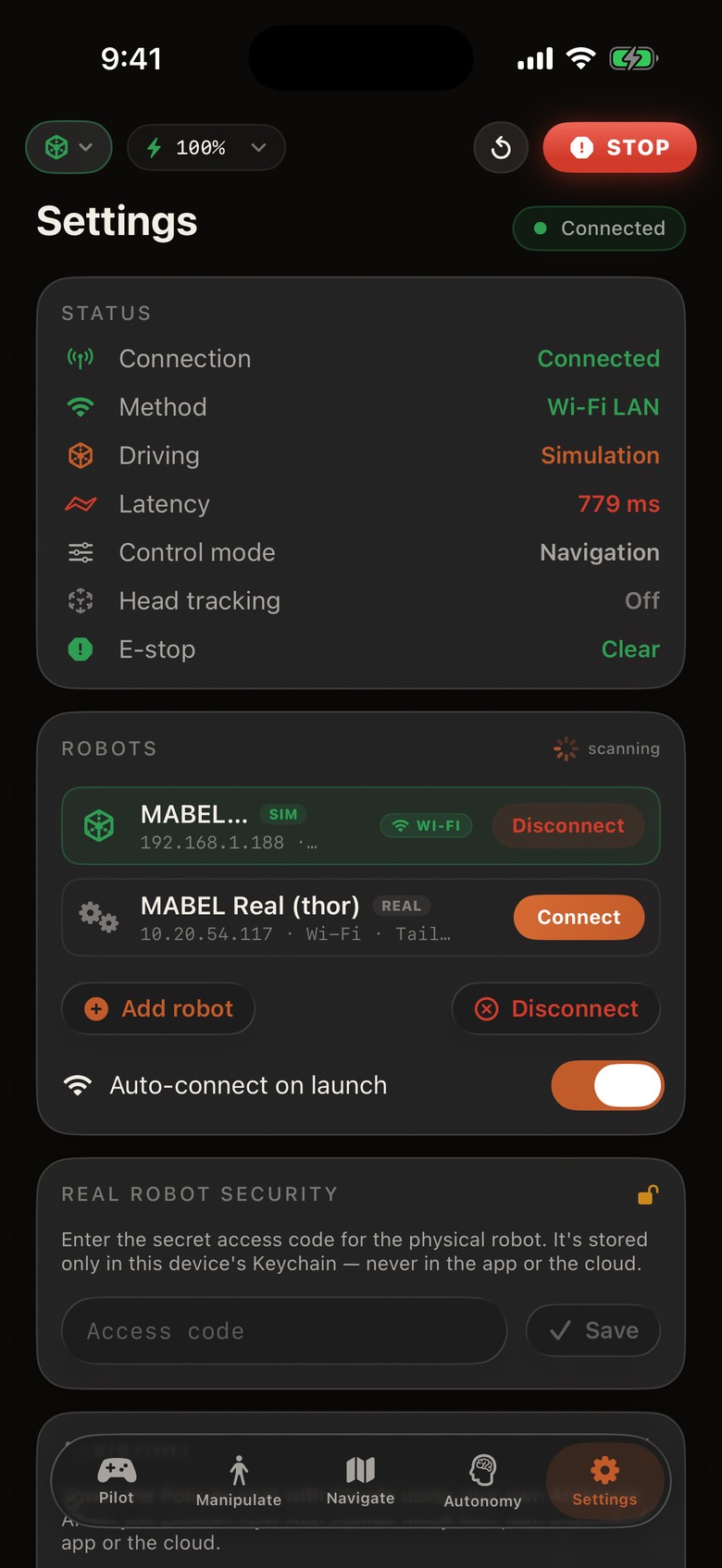
The Pilot cockpit: left stick translates, right stick turns and lifts, over live head and wrist feeds — with a speed governor and an always-present STOP.
Manipulate renders a live twin — drag a wrist, pick Firm or Soft, and how much body moves; the controller coordinates the rest.
On a real SLAM map, tap a goal: an A* plan routes around obstacles, then pure-pursuit drives it. See navigation.
A library of learned and scripted skills, each with its kind and an offline-eval success rate. One tap runs it on the robot or the twin. See autonomy.
Safety isn't a settings page you're trusted to read — it's the spine of the interface. Three promises hold on every screen, on both devices, whether you're an operator or a first-time guest.
A red STOP rides every screen and never scrolls away — one tap freezes all motion. Sleep the phone, lift the headset, or lose the link and the robot freezes itself: a heartbeat means it only moves while a human is actively holding on.
A speed dial scales everything from a crawl to full tilt. Hard speed caps live on the robot itself, every joint stops short of its mechanical limit, and letting go holds the pose under gravity comp — nothing springs back at you.
One driver holds the controls at a time; the robot must be explicitly armed to move; a stored access code gates every connection; and a live health panel flags a hot motor or a joint near its limit before it bites.
Latency and retargeting — measured, not promised.
Which headset? The Apple Vision Pro runs the native visionOS app — ARKit head pose plus a 27-joint skeleton per hand, and it is simultaneously visualizer, controller, and demonstration recorder. Other headsets (a PICO, a Quest) drive MABEL through the zero-install browser client instead — same wire protocol, no app store. All retargeting runs server-side either way.