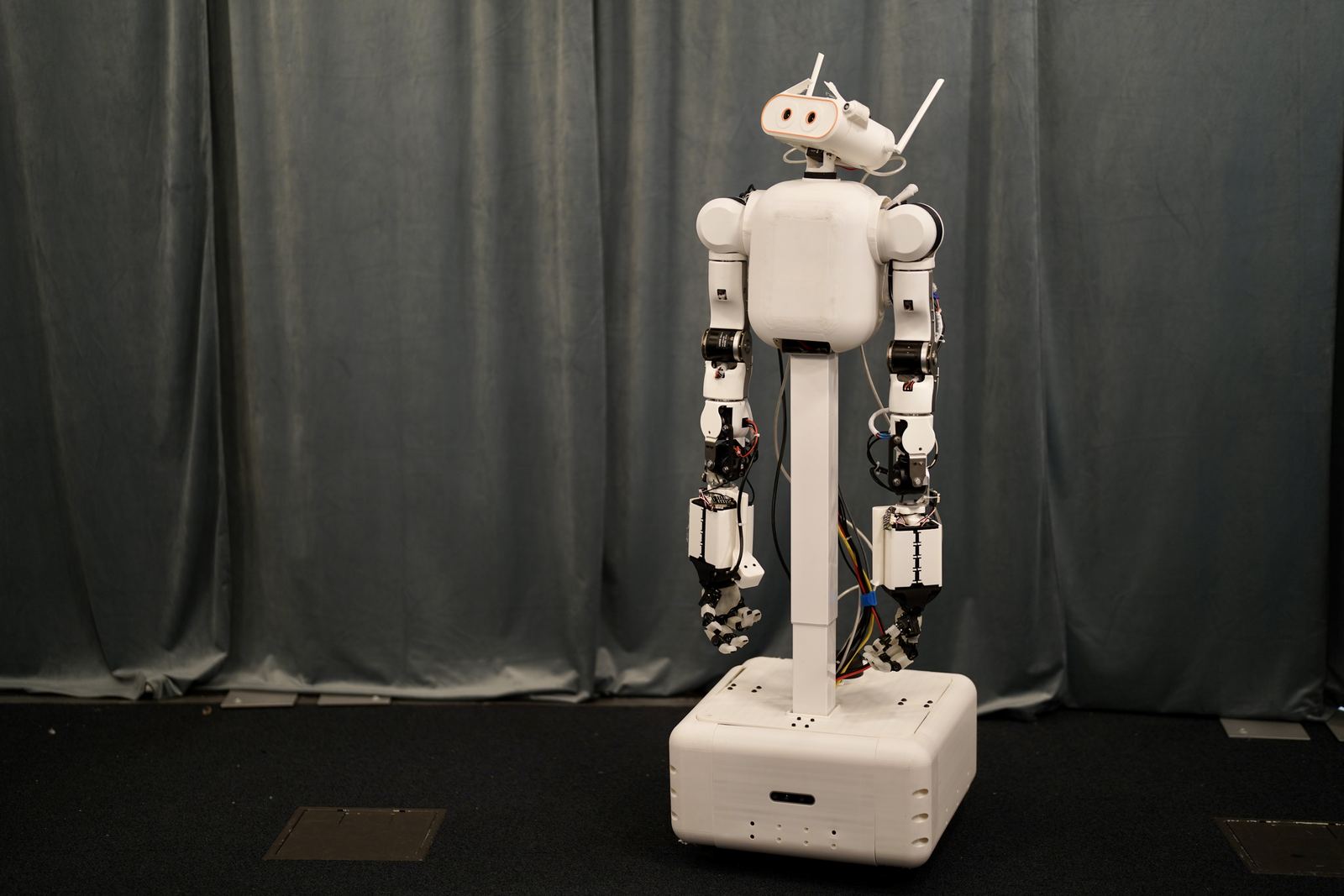
What is MABEL?
MABEL is a mobile bimanual robot: a holonomic swerve base, a 0.635 m lift, a torso, two 7-DOF arms, a 3-DOF head and, as standard, two 17-DOF dexterous hands built from the open ORCA Hand design, for 56 functional degrees of freedom. The software is released under Apache-2.0, the hardware under CERN-OHL-S-2.0 and the documentation under CC BY 4.0.
When can I buy one?
Not yet. Leave your details in the form above and we will write when assembled robots, kits and parts open. Nothing is charged or reserved by the form.
Can I build MABEL myself today?
Yes. The plans, the bill of materials with every vendor named and the illustrated build guide are free in the DIY guide.
What can MABEL do today?
It can be teleoperated from a Vision Pro, an iPhone, a browser or a gamepad; record demonstrations to LeRobot datasets; map and navigate a space with a lidar through SLAM and Nav2; and run trained policies on its on-board compute. A MuJoCo twin of the whole robot is free to use now.
How big is MABEL?
The base is 0.49 m across. The lift travels 0.635 m, placing the shoulders anywhere from table height to above a standard counter, and the arms span 2.23 m fingertip to fingertip.
Is MABEL safe around people?
A hardware E-stop de-energises every actuator independently of the computer, every command path is covered by a watchdog, and a tip-over model bounds the base's motion by the robot's centre of mass. MABEL is a research platform rather than a certified consumer product, and it should be operated under supervision as described in the safety chapter of the wiki.
Do I need a Vision Pro?
No. The iPhone app, the browser control centre, a gamepad and the keyboard all drive the robot. A Vision Pro adds whole-body teleoperation.
 MABEL