SOMEWHERE ON EARTH
v1.0 platform release
Open hardware · open software
Made open, made repeatable.
Mobile Bimanual Robot · Open Platform

A robot that does the work.

56 actuated degrees of freedom. From $8,722. Fully open. Two dexterous hands, a holonomic base, and whole-body autonomy — onboard.

The MABEL Project

Scroll
Abstract

A whole-body robot you can actually build.

Capable mobile bimanual robots are proprietary; open ones are fixed-base with parallel-jaw grippers. MABEL is neither: 56 functional DOF — holonomic base, 0.635 m lift, actuated torso, active head, two 7-DOF arms, two 17-DOF hands — built for $9,670 with no machine shop, MIT-licensed end to end. One consumer headset is visualizer, controller, and demonstration recorder at once.
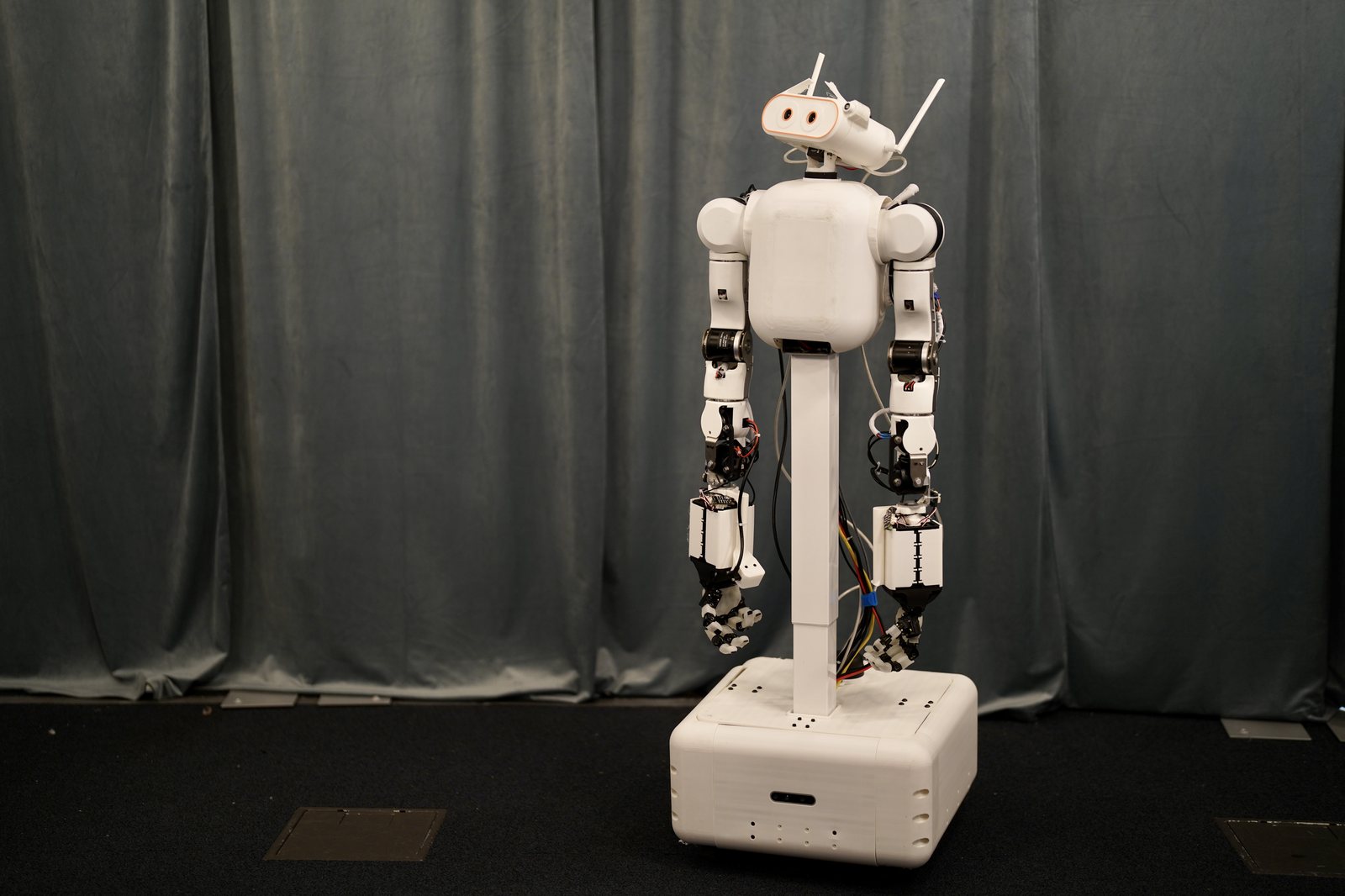
56 DOF · 59 motors0–2.23 m reach0.49 m footprint 500 Hz twin$9,670 as builtMIT license
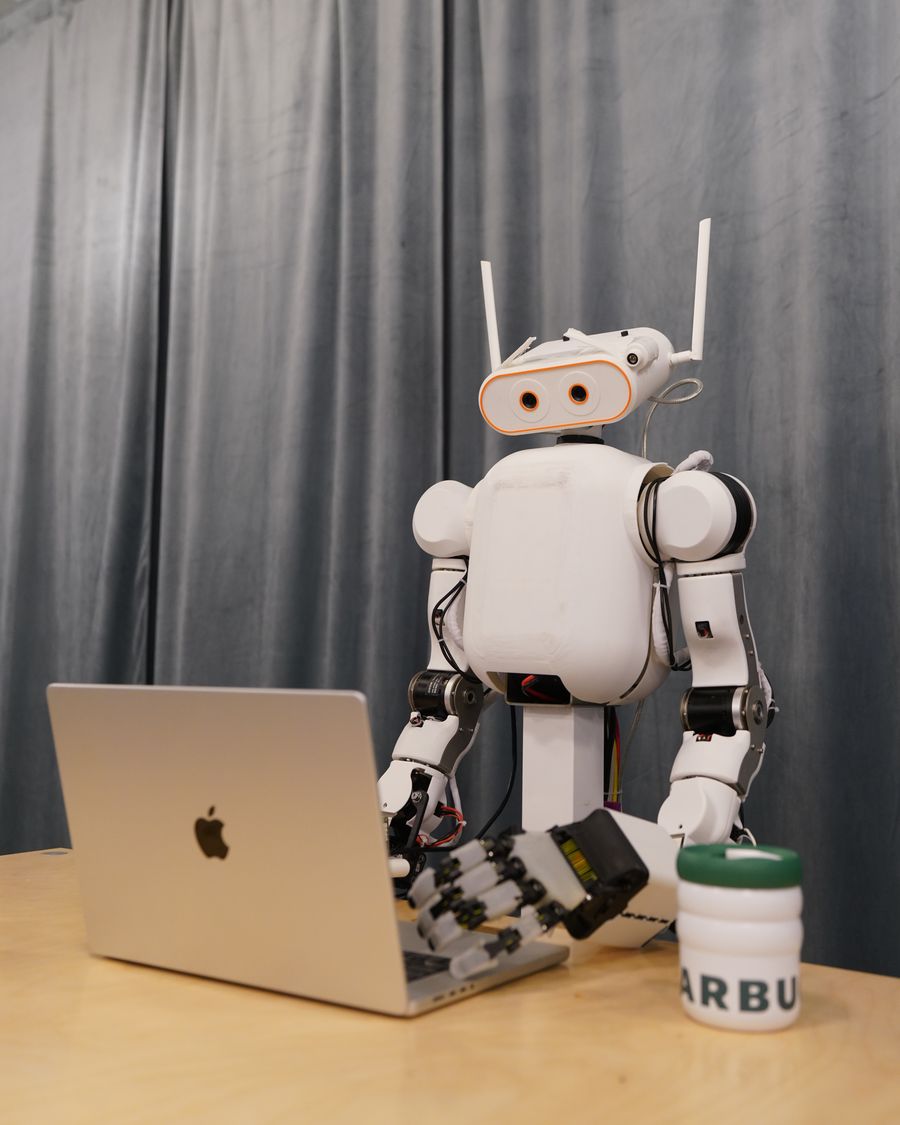
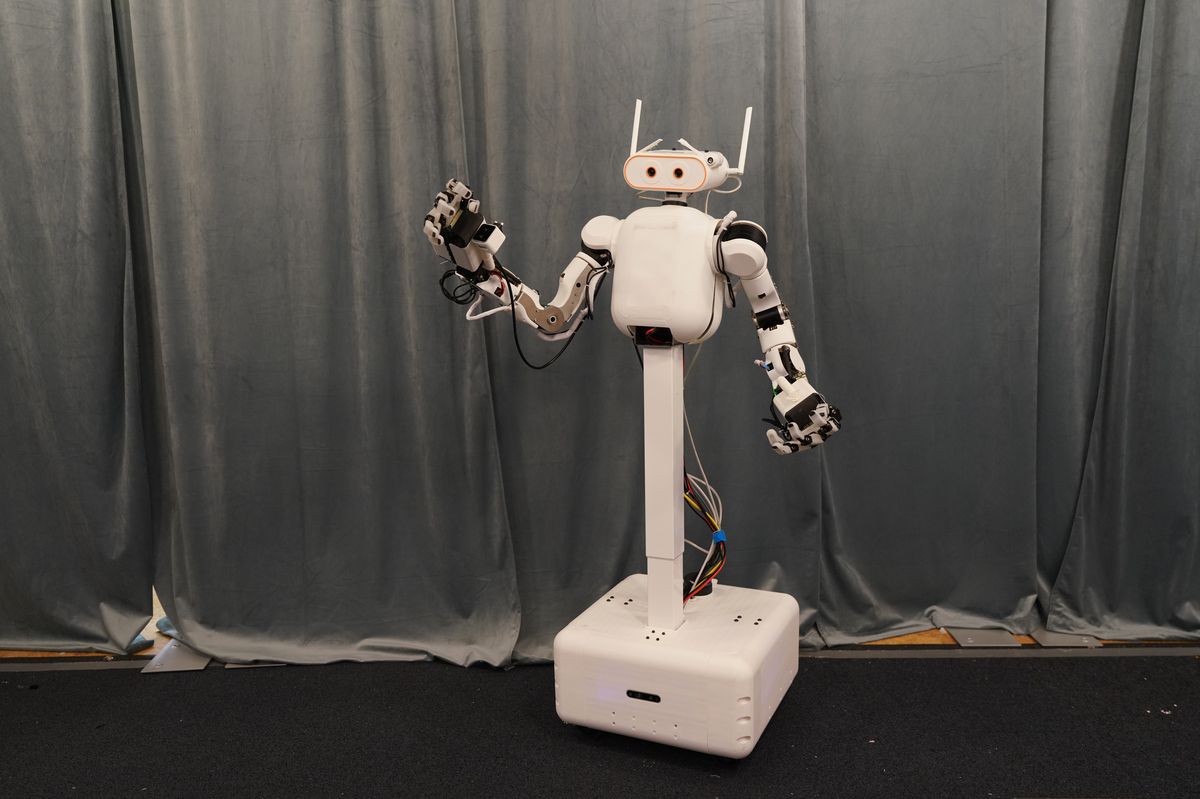
MABEL v1.0, as built — white shells, twin ORCA hands, swerve base

v1.0 · as built · no renders

Cheap, dexterous, whole-body

$9,670 as built. Two 17-DOF hands, two 7-DOF arms, a 3-DOF active head, and a holonomic swerve base — a 0–2.23 m fingertip band on a 0.49 m footprint. The only open platform that is holonomic, hand-dexterous, and neck-articulated under $10k.

Modular by construction

Every subsystem is its own project on its own bus — swap an arm, a hand, the base, or the head without touching the rest. Extrusion + sheet metal; no machine shop; MIT-licensed CAD, firmware, and software.

Simulation-complete

A MuJoCo twin runs the production control code unmodified at 500 Hz across 35 released environments. Same URDF, same ROS 2 interface — use_sim:=true is the only difference.

One integrated system

Teleop (Vision Pro, iPhone, browser), electronics and firmware, data collection, and training are one stack: every command passes one wire protocol and one whole-body QP — and every session is a training demonstration.

Try it now · no install

Drive it, right here.

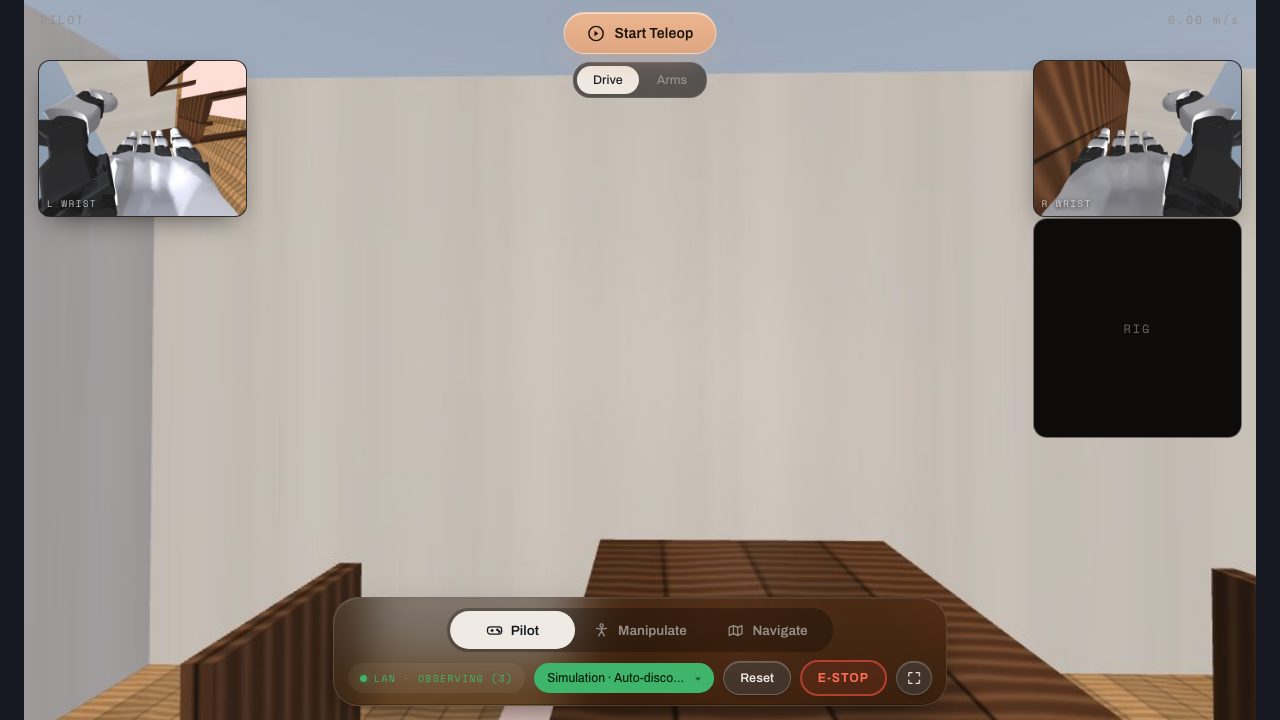
The real operator console, embedded. Joysticks, body control, and navigation on an in-browser kinematic twin — the same teleop_frame wire protocol the iPhone and Vision Pro apps speak. Press power and take the wheels.

The MABEL browser simulator console Take the wheels!
Runs on your phone too
The system

One platform, end to end.

MABEL is vertically integrated: operator intent and learned policies enter at the top and descend through onboard intelligence, a single ROS 2 graph, and per-MCU firmware until they become torque at 56 joints — while joint state, odometry, and vision flow back up. A MuJoCo twin mirrors every interface. Hover any block for what it does; click to open its page.

0DOF
Functional DOF
59 motors
0m reach
Fingertip band, floor
to overhead
0Hz
Twin runs the production
controller, unmodified
0k USD
As built — under
ten thousand
▼ commandsstate ▲
Onboard intelligence · Jetson Thor
▼ joint targetsjoints · odometry · vision ▲
ROS 2 middleware · mabel_ws
the stack is identical down to ROS 2 — pick a world
01
One source of geometry

A single URDF generates the MJCF for simulation, the on-robot kinematics, and the web's articulated viewer — sim and hardware can't silently diverge.

02
One graph, two worlds

Every firmware bus surfaces in ROS 2 behind standard topics; the same graph drives the real robot or the twin — use_sim:=true is the only difference.

03
Base to fingertips, one solve

The whole-body controller resolves base, lift, torso, and arms against one task — a 6-DOF wish becomes coordinated motion across 56 joints.

04
Teleop is the data engine

Every teleoperated session is logged as a labeled trajectory that trains the policies — the same interfaces that drive the robot also feed the learning loop.

Anatomy

X-ray the robot.

Pick a module and the rest of MABEL turns to glass — drag to orbit while it breathes, sways, and ripples its fingers. The full explorer and the hardware chapter go deeper.

Look inside me!
Loading MABEL · anatomy rig
Drag to orbit · scroll to zoom
Teleoperation

One robot,many pilots

The Apple Vision Pro runs the native app — head, hands, and gaze. A PICO (or any WebXR headset) drives the same robot through the browser client. One wire protocol either way, and every session is a training demonstration.

Do as I do!
Field notes

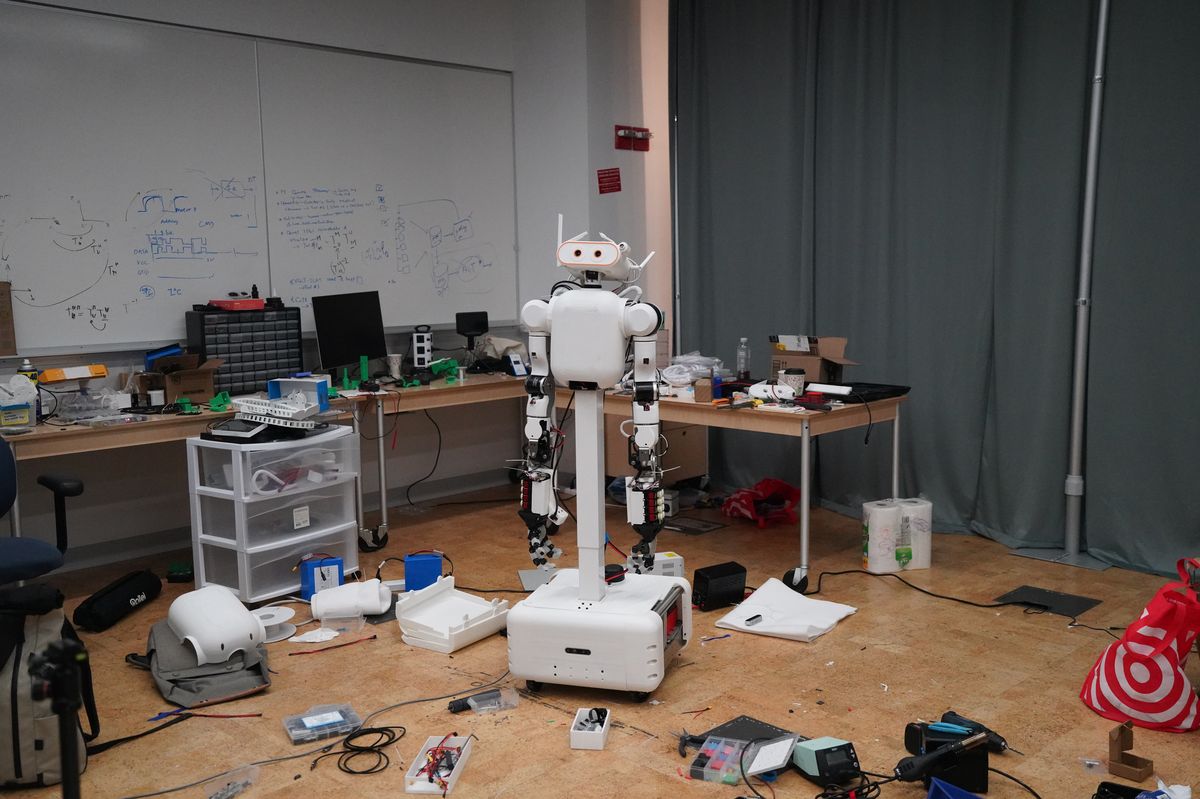
Shop to street.

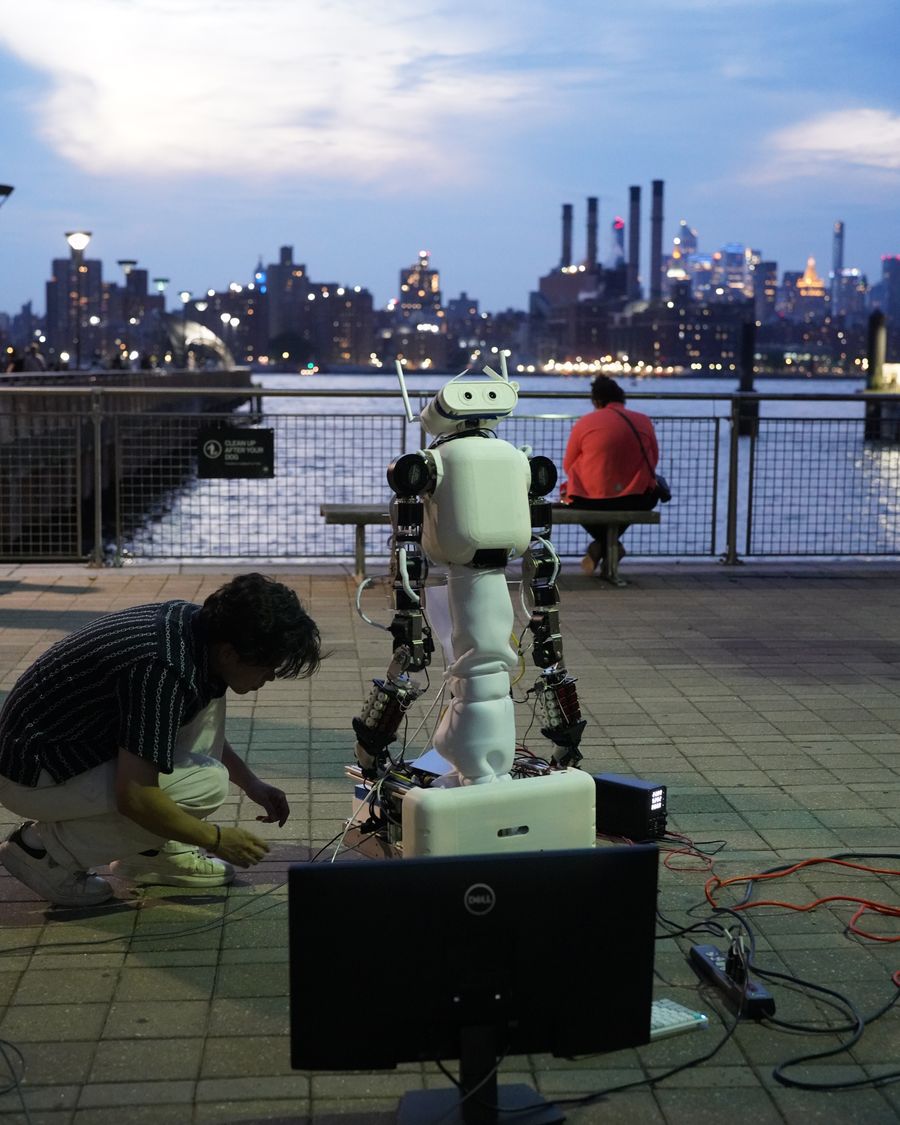
Real frames from the build log — the bench, the first time it typed, the day it walked the Brooklyn Bridge. Clips loop on their own; sound stays off.

Do as I do — Vision Pro mirror mode
Mirror mode · Vision Pro teleop
Office hours
Office hours
Crossing the Brooklyn Bridge
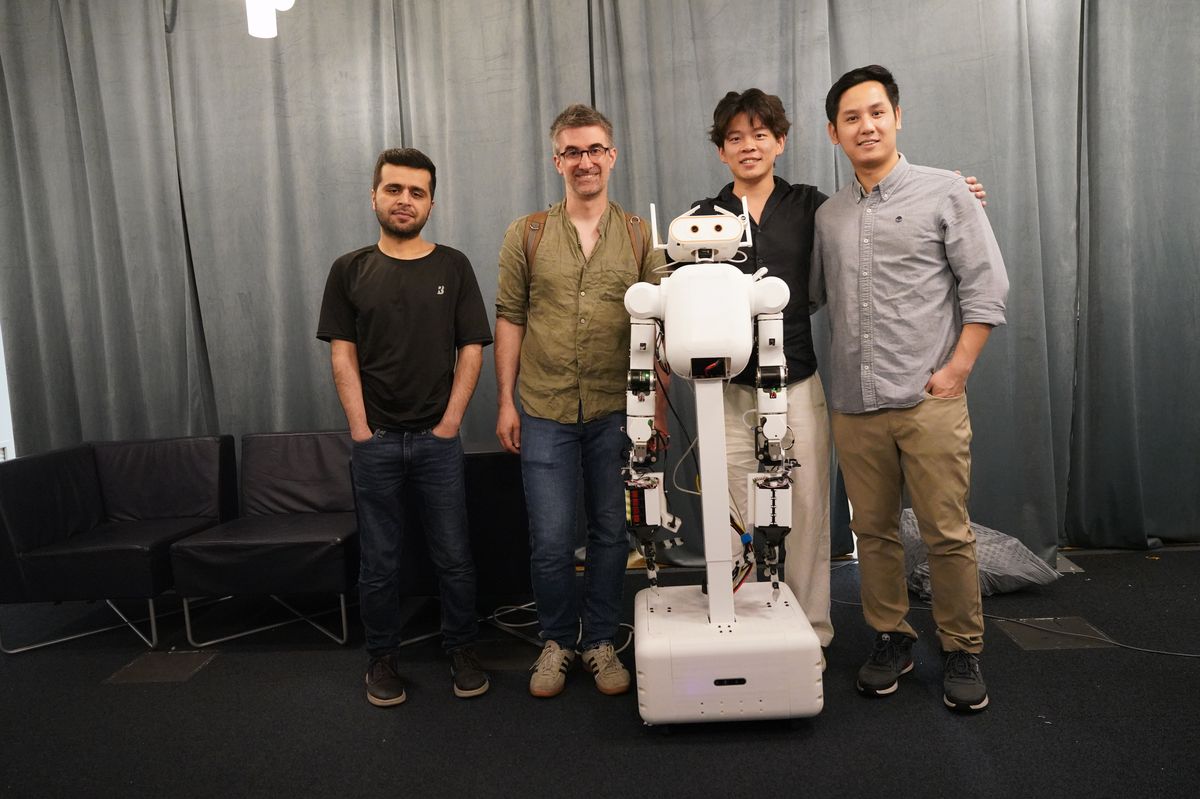
We built a robot!The crew · launch week
The crew · launch week
17-DOF ORCA hand
56 DOF, all present
56 DOF, all present
Say hello, MABEL
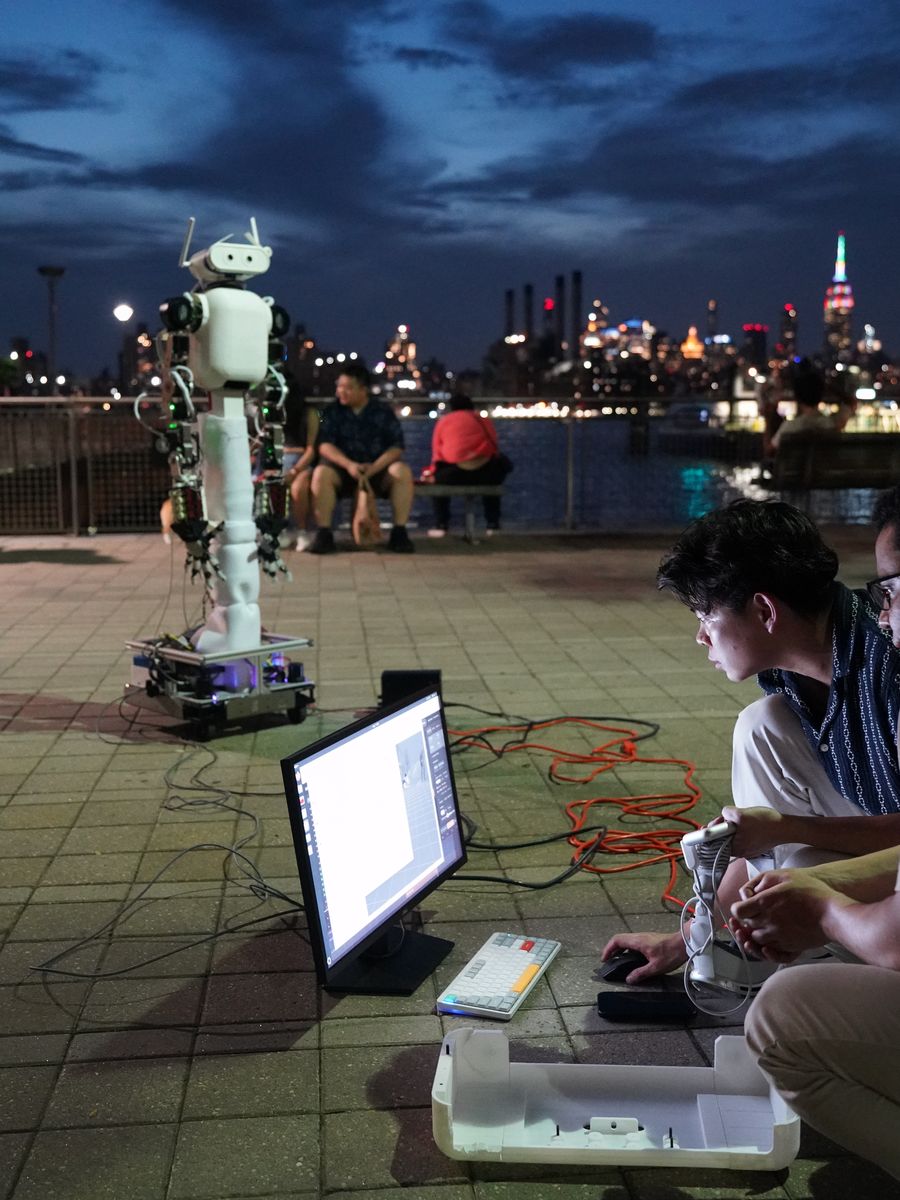
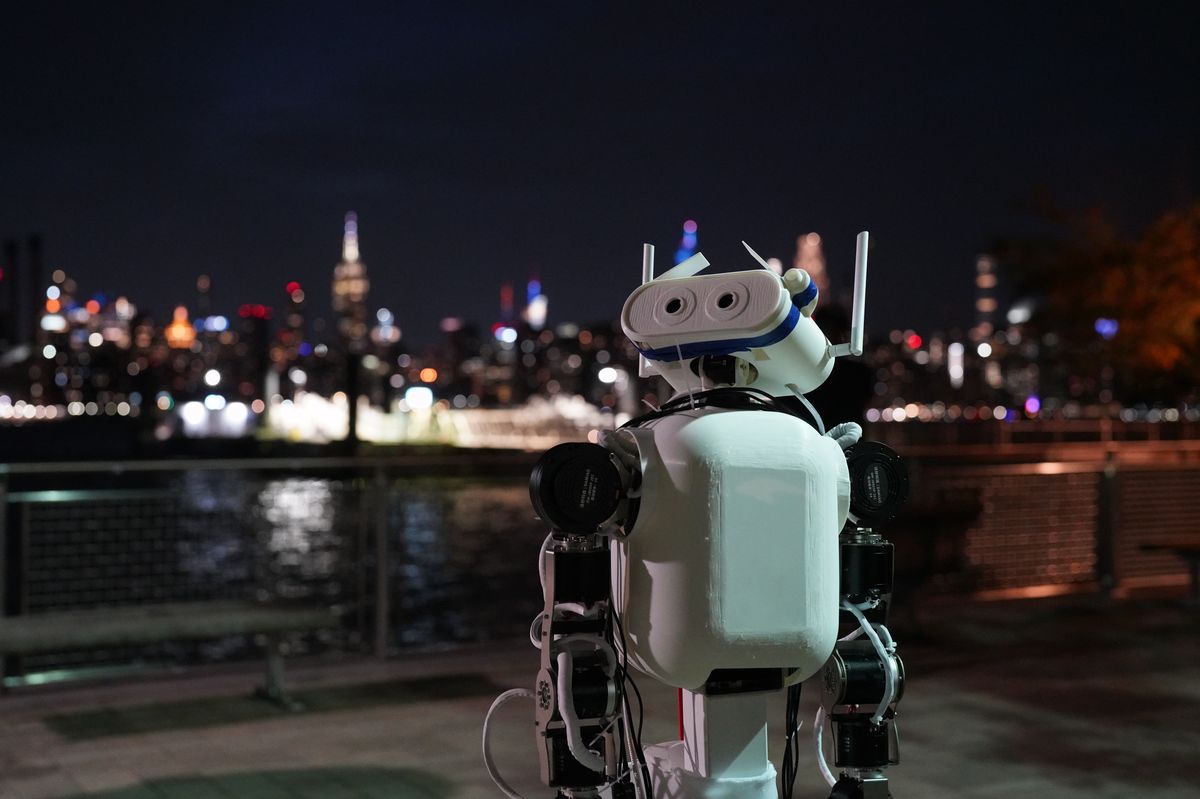
Night ops · East River
Night shift, Manhattan across
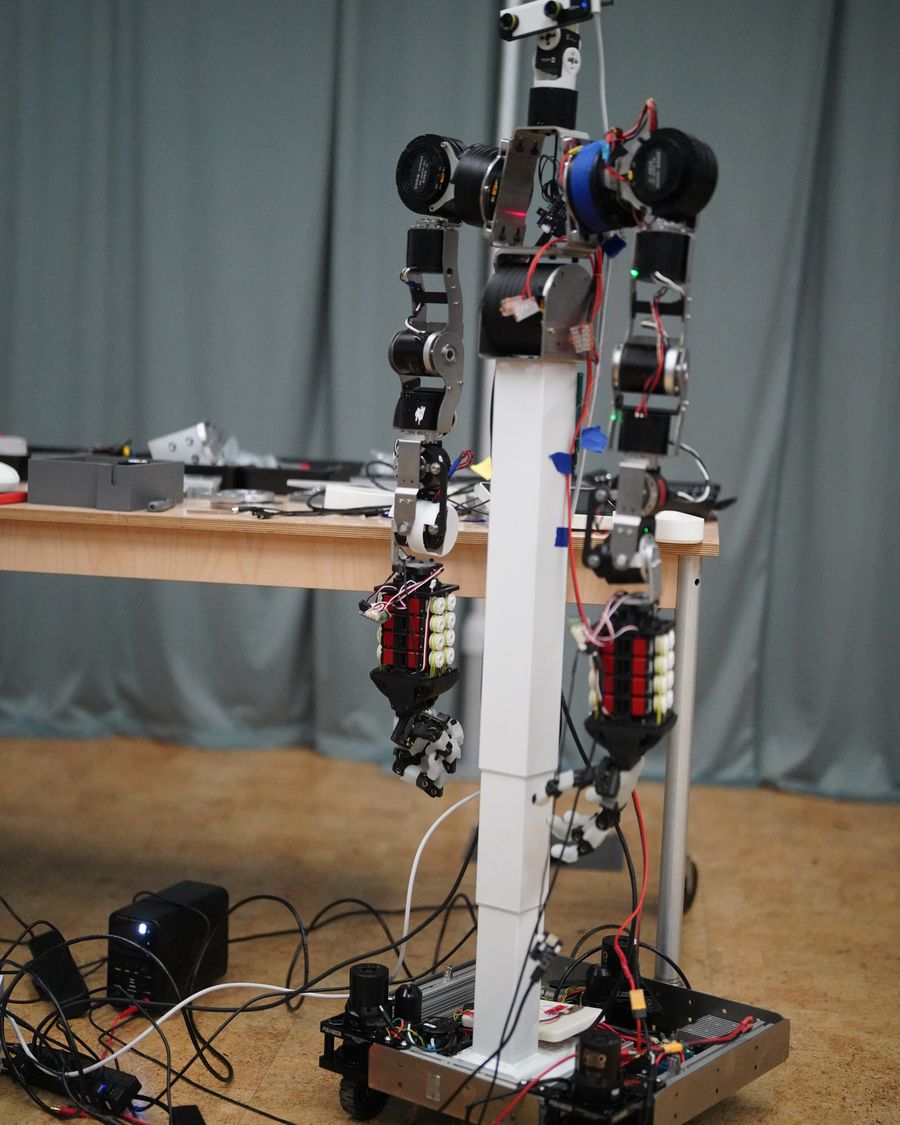
Week two · arms on the bench
Making friends
Born in the shop
Born in the shop
Inbox zero, eventually.
Inbox zero, eventually
Long-horizon run · elevator included
Golden-hour field rig
Manhattan, meet MABEL

Meanwhile, on a Manhattan sidewalk…

In the wild

MABEL in the wild.

We took the robot outside — across bridges, through plazas, around tourists. The platform that handles a Manhattan high-rise should also handle a Manhattan sidewalk. Crowds, curbs, glass doors, and uneven pavement are not edge cases here; they're the test set.

High above the East River…
01
Brooklyn Bridge
40.7061° N
73.9969° W
Moments later, in Times Square…
02
Times Square
40.7580° N
73.9855° W
03
The Oculus · WTC
40.7115° N
74.0134° W
04
Rolling out
On location
05
Williamsburg
40.7081° N
73.9571° W
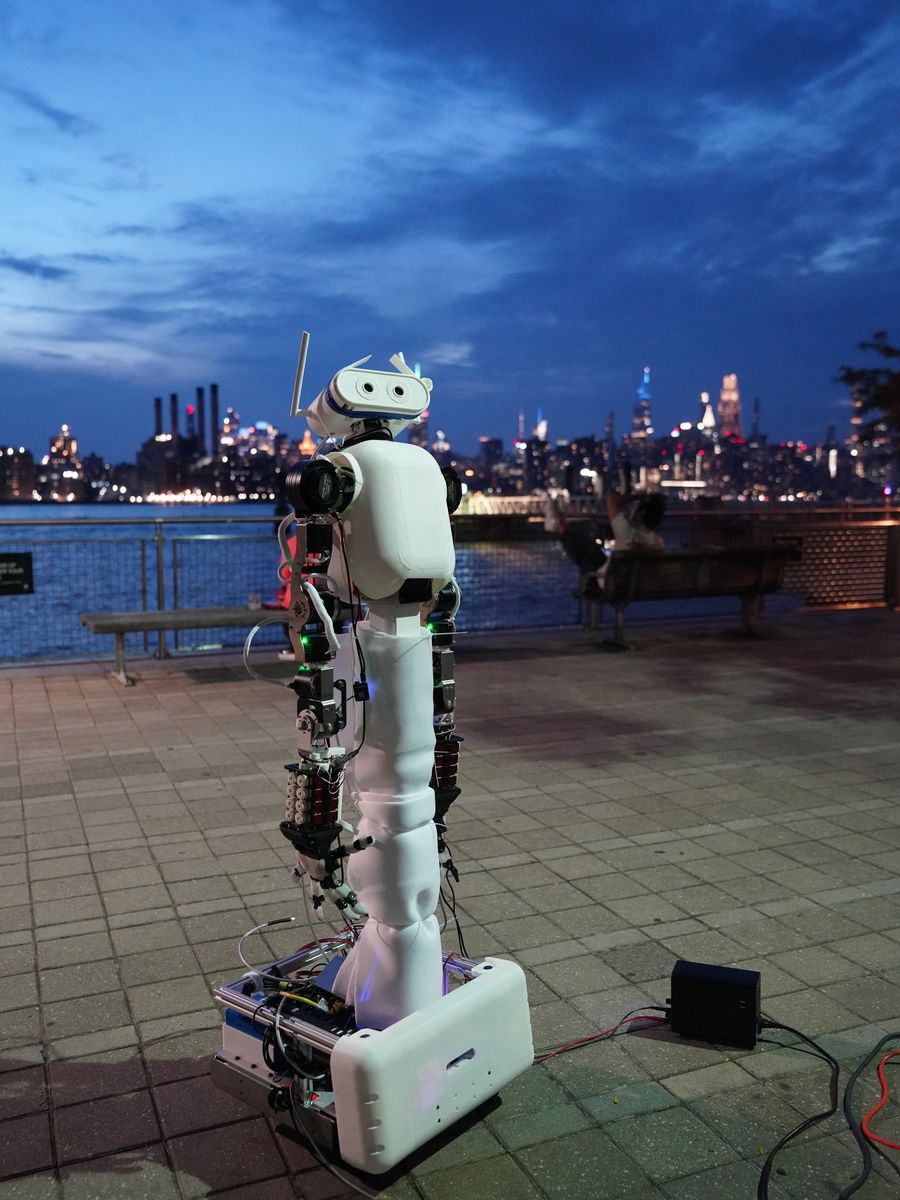
MABEL on the East River waterfront at dusk
06
East River dusk
On location
Why MABEL

How it stacks up.

The only open platform that is holonomic, hand-dexterous, and neck-articulated — for under $10k. Here is the field, surveyed honestly.

Survey · July 2026

PlatformHolonomicArmsHand DOFNeck DOFLift / torsoFloor ↔ overheadOpenCost
Mobile ALOHA6×210$32k
XLeRobot5×210$0.66k
LeKiwi5×110$0.6k
YOR6×210lift$9.3k
Reachy 27×213$70k
Stretch 3tel.×112lift$25k
Galaxea R17×210torso$27k
Unitree R1-A77×21–72lift+torsofrom $4.3k
DexMate Vega7×263lift+torso$90k
MABEL (ours)7×2173lift+torso$9.7k

Reach · floor to overhead

tablehigh shelf MABEL0.00–2.23HUMAN0.00–2.18MOBILE ALOHA0.65–2.00YOR0.00–1.86TIDYBOT++0.00–1.28XLEROBOT0.50–1.25 012FINGERTIP HEIGHT · METRES
The paper

System paper · under review

A full system paper — the hardware, the teleop stack, the whole-body controller, and the measured numbers — is under double-blind review. The build guide and per-subsystem reports in the repo cover the same ground.

GitHub repo ↗
@misc{mabel2026,
  title  = {{MABEL}: An Open Anthropomorphic Mobile
            Bimanual Platform for Teleoperation
            and Learning},
  author = {Anonymous (under review)},
  year   = {2026},
  note   = {robotmabel.github.io/website}
}
The studios

One robot, three studios.

Everything MABEL does runs through a browser studio: fly it live, curate what it recorded, then train the policy that flies it next.

01 · OPERATE

Control Studio

The simulated robot serves its own cockpit: an rviz-class 3D viewer (live rig inside its SLAM map), drive + manipulate teleop with an IK target ball, dexterous-hand control, 59-DOF telemetry with temperature grading, and a live monitor of every connected client.

Open the Control Studio ↗
Open demo · no install
02 · CURATE

Data Studio

Final-Cut-style curation for imitation-learning data: auto-flag dropped frames, sync drift, and dead motors; grade every episode; align, blade, and trim non-destructively; export a clean LeRobot dataset with the 3D viewer and seven synced cameras for review.

Open Data Studio ↗
Live demo
03 · TRAIN

Policy Studio

Explore the exact training graphs — ACT, Diffusion Transformer, π₀ / π₀.₅ — down to individual attention blocks, then queue a real training job on MABEL's GPU from a curated dataset. Results and learning curves are published back to the site.

Open Policy Studio ↗
Live demo